
Three Scenarios for a US Attack on Iran

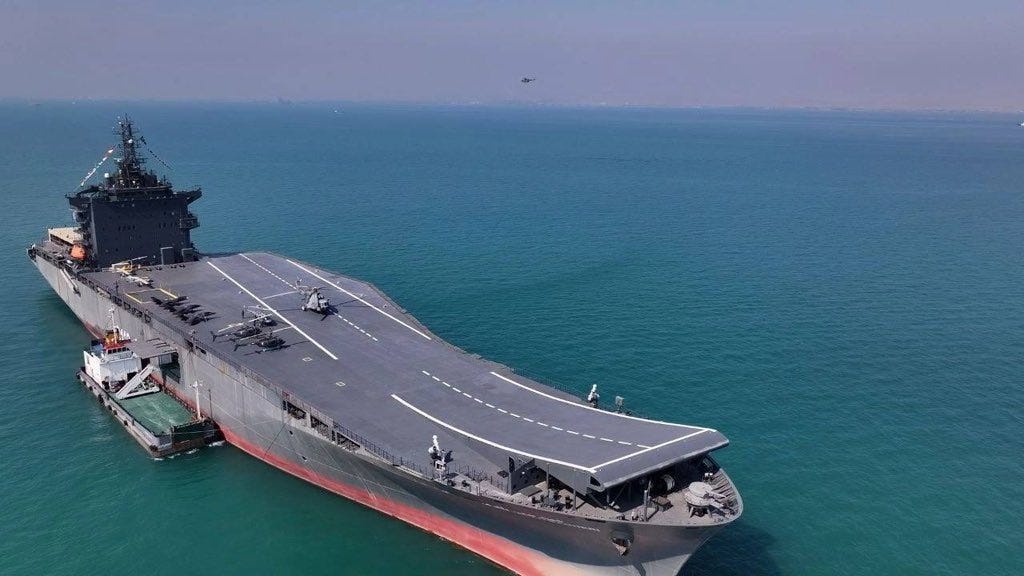
Based on recent statements by Donald Trump and various members of the Iranian government and military sectors, we are headed to a new war in the Persian Gulf. But it is not just the words that concern me… If you compare the totality of US military assets that were deployed to the Persian Gulf area prior to Israel’s surprise attack on Iran in June of 2025 with what is now being assembled, the picture is very ominous.
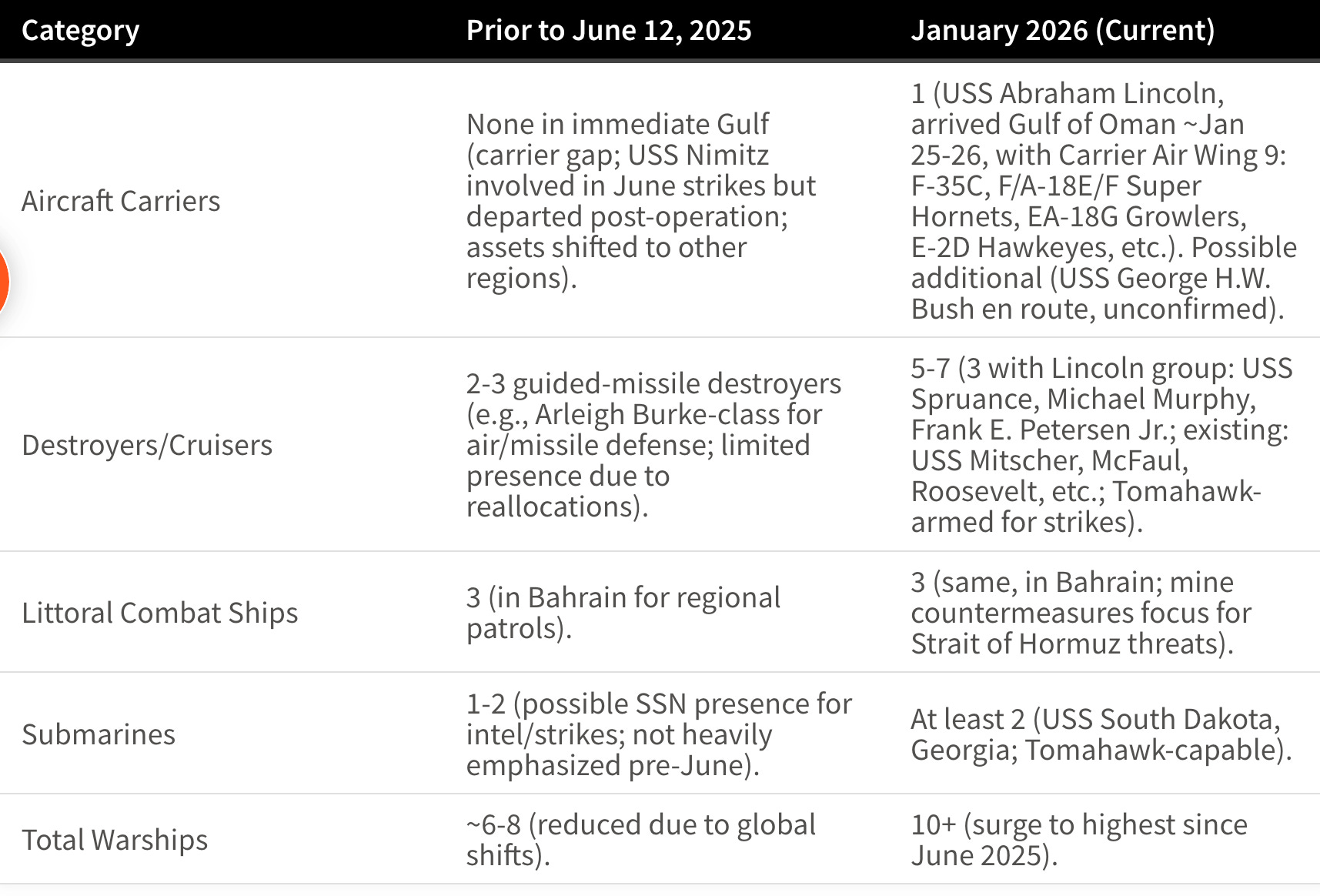
Comparative Table: US Naval Assets in the Persian Gulf Prior to June 12, 2025 compared to January 2026
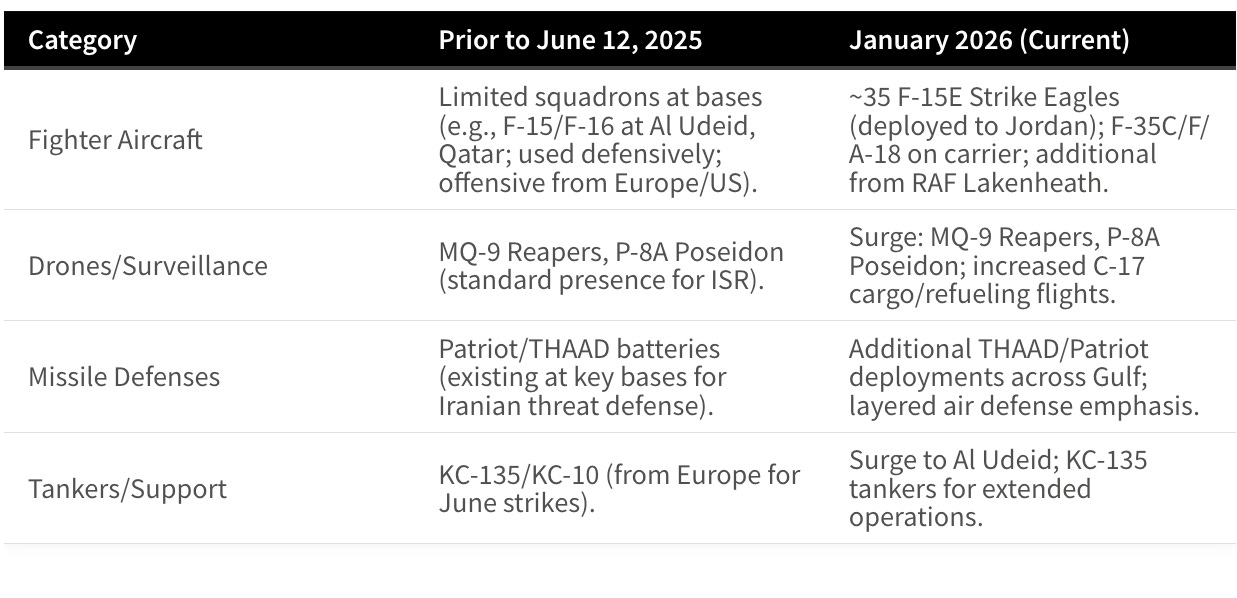
Comparative Table: US Air and Missile Defense Assets 2025 vs 2026
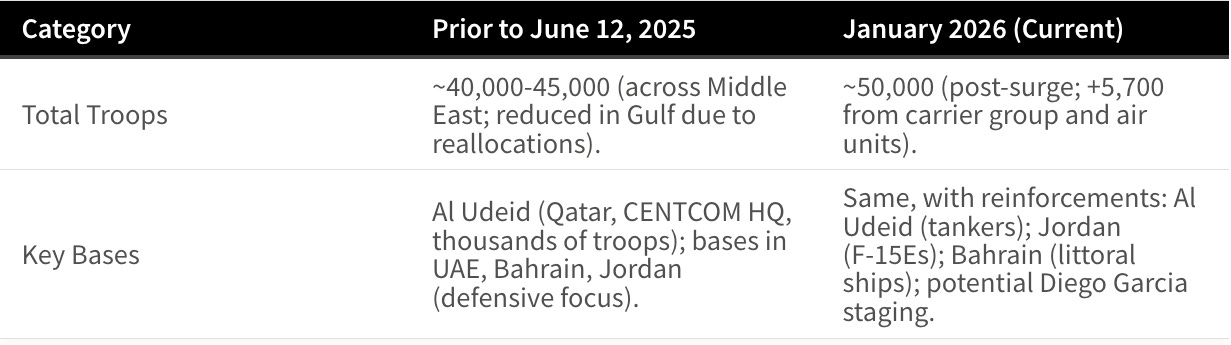
Comparative Table: US Ground/Troop Presence and Bases 2025 vs 2026
So let’s consider three possible scenarios:
SCENARIO 1: Despite bellicose statements by both the US and Iran, the Saudis, the Turks, the Chinese and the Russians are working frantically behind the scenes to secure a diplomatic solution. As a result of pressure from the Saudis and the Turks, Trump realizes the will not be able to fly over their territories, which imposes a significant limitation on US air operations. The Saudis and the Russians, with support from all of the Gulf nations, persuade Trump to open negotiations with Tehran. Crisis averted… at least for now.
SCENARIO 2: The US launches a successful combined air-to-surface and sea-launched missiles (i.e., Tomahawk cruise missile) at critical Iranian government, military and economic targets, which leads to a collapse of the Iranian government and ignites a civil war in Iran. Iran is unable to retaliate.
SCENARIO 3: The US launches a combined air-to-surface and sea-launched missiles (i.e., Tomahawk cruise missile) at critical Iranian government, military and economic targets, but Iranian air defense systems defeat a substantial number of the threats. In addition, Iran has deployed decoy missiles that the US, believing them to be real, strikes. Iran in turn launches an immediate barrage of missiles and drones. The first wave is intended to deplete the US and Israeli-air defenses. Iran then launches a follow-on attack against US military bases and installations in the Persian Gulf and in Syria. Iran also hits Israel and closes the Strait of Hormuz. A full-scale war ensues.
I am sure that some of you armchair warriors can come up with some additional SCENARIOS we should consider. I am hoping for SCENARIO 1, but I fear that SCENARIO 3 is the most likely. If combat operations last more than two weeks then the US will find itself in an almost impossible situation to sustain operations, especially if the Strait of Hormuz is closed. The most consistent public estimate for the operational U.S. Tomahawk inventory in early 2026 is approximately 3,500-4,500, leaning toward the lower end due to ongoing drawdowns and modest replenishment. This reflects a focus on quality upgrades (Block V) over quantity, amid broader munitions shortages.
If Iran targets the US carrier task force with a huge drone and missile swarm, the destroyers and cruisers providing protection for the carrier will rapidly deplete their supply of defensive missiles… The only way they can re-load is to travel to a port facility that is specially equipped to handle the re-loading. Normally the US ships would go to Bahrain, but if the Strait of Hormuz is closed those ships will have to find an alternative site, which means the carrier will also withdraw from the Arabian Sea. The worst case scenario here is that the Iranians hit the carrier and take it out of action.
Unlike Venezuela, Iran represents a formidable military challenge. Iran maintains one of the largest and most diverse missile arsenals in the Middle East, primarily focused on ground-launched systems operated by the Islamic Revolutionary Guard Corps (IRGC) Aerospace Force. As of early 2026, Western estimates indicate over 3,000-4,500 ballistic missiles and around 1,000 cruise missiles in inventory, with ongoing production and upgrades post the June 2025 strikes on its facilities. However, I believe that Western estimates dramatically under count what is actually in the Iranian inventory because the vast majority of Iranian missiles are stored underground in hardened shelters.
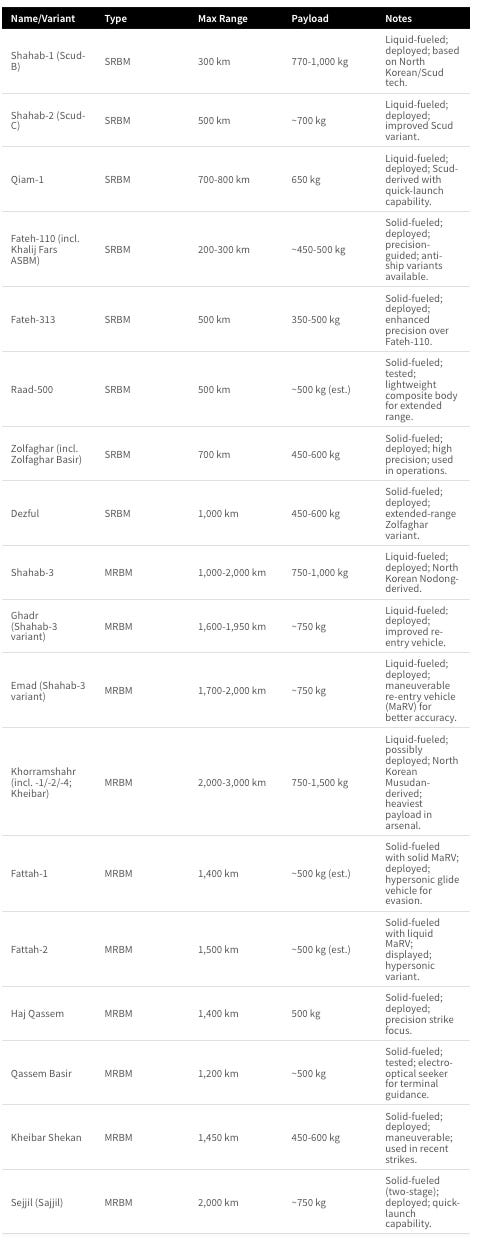
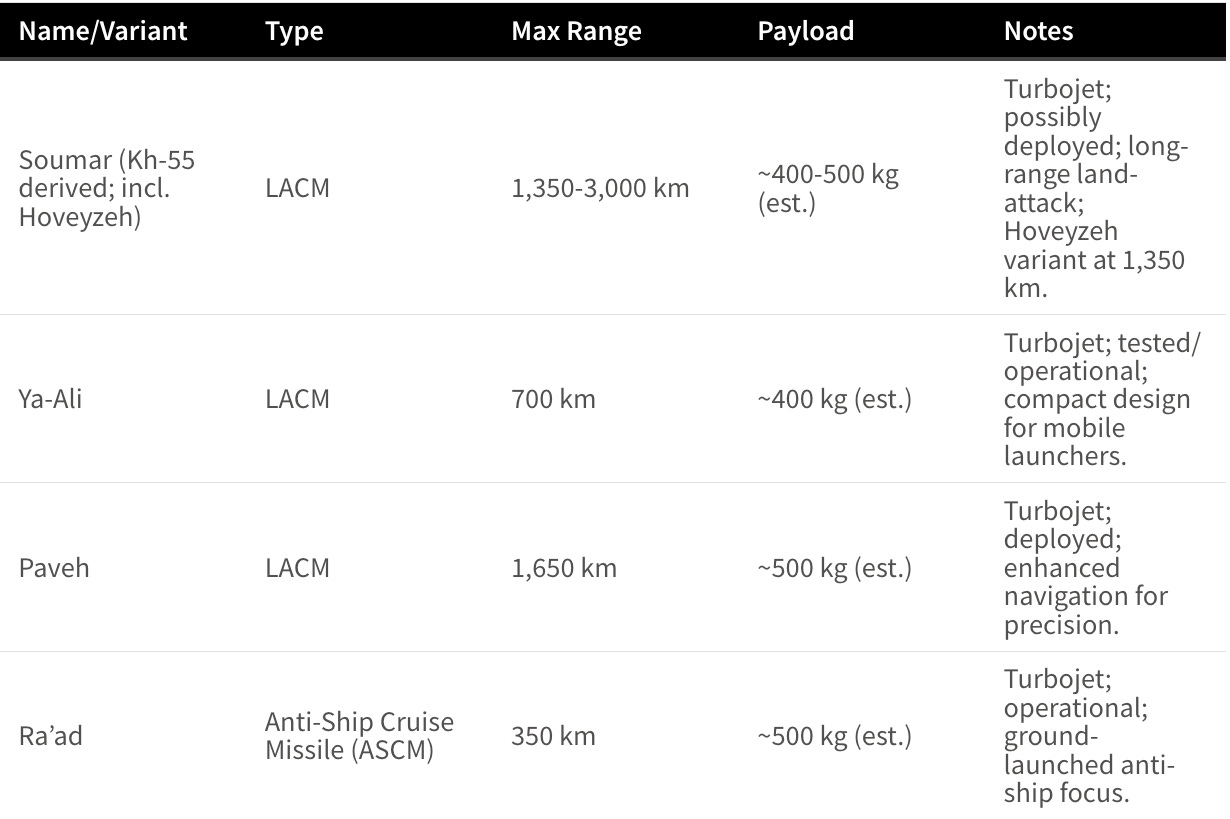
The Iranian arsenal includes short-range ballistic missiles (SRBMs, <1,000 km), medium-range ballistic missiles (MRBMs, 1,000-3,000 km), and land-attack cruise missiles (LACMs), many with anti-ship variants. Ir addition, Iran recently successfully tested an intercontinental ballistic missile (ICBM). I think you will find the following Tables absolutely stunning:
Ballistic Missiles (18 Types/Variants)
These are primarily solid- or liquid-fueled, with improving accuracy (circular error probable, or CEP, often <100 m for newer models):
Cruise Missiles (4 Types/Variants)
These are turbojet/turbofan-powered, subsonic, with terrain-following guidance for low-altitude evasion; often derived from Soviet/Chinese designs.
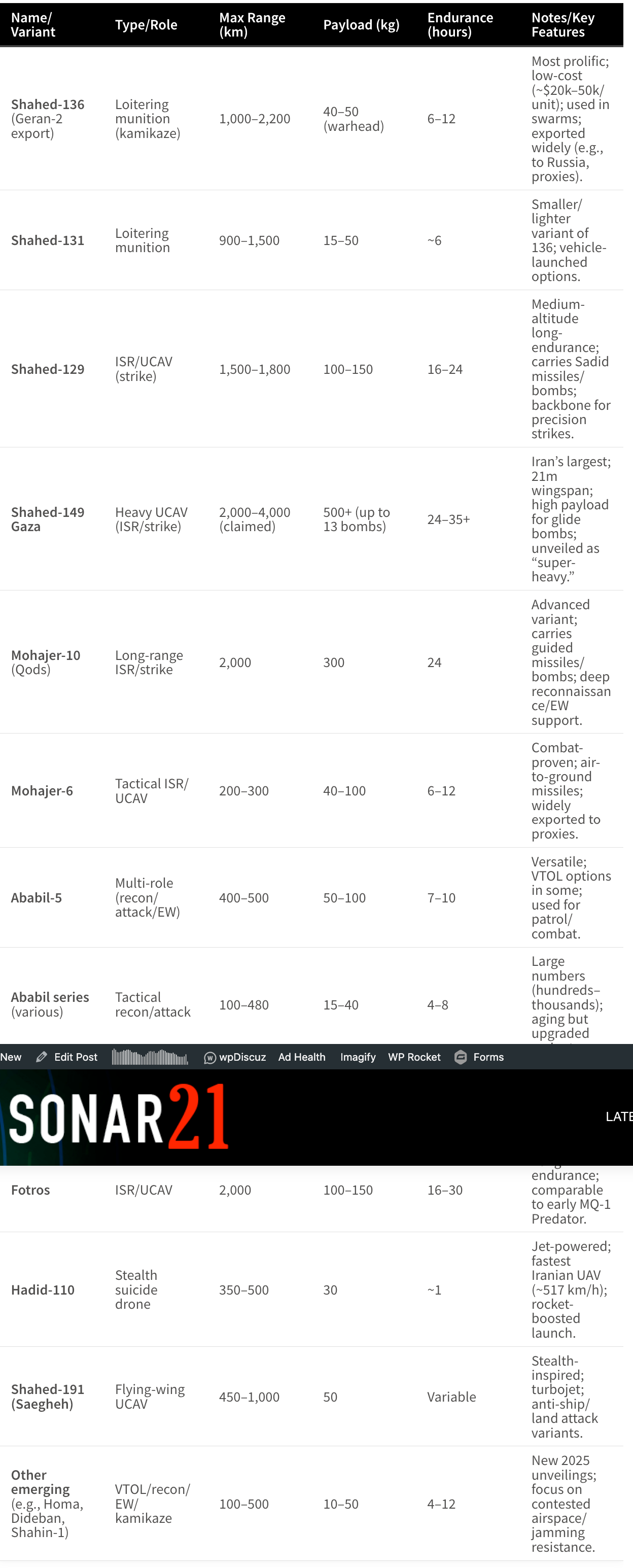
Then there are the drones. Iran’s fleet of drones (unmanned aerial vehicles, or UAVs) is one of the largest and most diverse in the Middle East, with thousands in service across reconnaissance, strike, and loitering munition (“kamikaze”) roles. Operated primarily by the Islamic Revolutionary Guard Corps (IRGC) Aerospace Force and the regular army (Artesh), the arsenal emphasizes low-cost, asymmetric capabilities, mass production, and export to proxies (e.g., Houthis, Hezbollah, militias in Iraq/Syria).
As of early 2026, Western estimates place Iran’s active UAV inventory at around 3,000–4,000+ units (recon-attack and ISR combined), with significant growth from new procurements (e.g., 1,000+ long-range drones added in 2025 reports) and domestic production despite setbacks from the June 2025 strikes. Here again, I believe that Western intelligence has grossly underestimated the size of Iran’s drone fleets. Iran operates dozens of types/variants, but the core fleet revolves around a few key families: Shahed (loitering munitions and strike), Mohajer (multi-role ISR/strike), Ababil (tactical recon/attack), and others like Shahed-149 Gaza (heavy endurance).
There are roughly 15–20+ distinct types/variants in widespread use (excluding minor prototypes or proxy-modified versions), with ongoing unveilings of new models (e.g., Hadid-110 stealth suicide drone in late 2025, Homa/Dideban/Shahin-1 VTOLs in 2025). The focus is on endurance, swarming potential, and low-observability for saturation attacks.
Key Drone Types and Capabilities
Here’s a summary of major operational or recently highlighted types, based on open-source assessments (ranges and payloads are approximate/maximums; actual performance varies with configuration, fuel, and payload trade-offs):
Word to Trump… Iran ain’t Venzuela. If Trump chooses to go to war with Iran I think it could ignite a crisis that could end his presidency instead of destroying the Islamic Republic of Iran.
Danny Davis and I discussed the consequences of going to war with Iran:
Who does the American patriot root for in this unprovoked attack on Iran? Must we root for Option 2, because we are Americans, and we are required by our birthplace to support our government even when it behaves like Hitler's Germany? I personally cannot root for an American win in a battle against an innocent "enemy", when this supposed "win" will then prompt more unprovoked on more innocent nations. So I have to do what I have never done and root for a quick but decisive defeat that includes a serious public repudiation of the Trump and Netanyahu immoral and unconstitutional war. At some point all this fake and lying American and Israeli covert behavior has to be confronted publicly and rejected in a manner that includes legal action against the perpetrators. This is all against the best interests of the world and against the moral codes and serious religions that have been generally accepted across the ages. Our behavior in recent times has been completely dark and done with no public debate and no seeking the will of the people. It is all deception and it must stop. So, however sad it is it is our obligation in my view that we publicly support Iran in its defense against the aggression of the cabal that is leading our government right now.
I think and hope! that Scenario 1 is a possibility, given the positions of Iran's neighbors and Russia and China. The thing about #1 is that Iran has had enough of Trump's 'deals'. The US would just go away for awhile, and then the same escalating threat-talk and military build-up would happen again. Israel is the persistent mosquito that won't leave the US' ear alone.
And...if DJT thinks that attacking Iran will help lift his poll numbers in the US, he is certainly mistaken. What a mindset!~starting a big war to raise one's popularity. Devilish thinking.