
Trump’s Plan to Economically Bully China Has Failed… Scott Bessent is Clueless

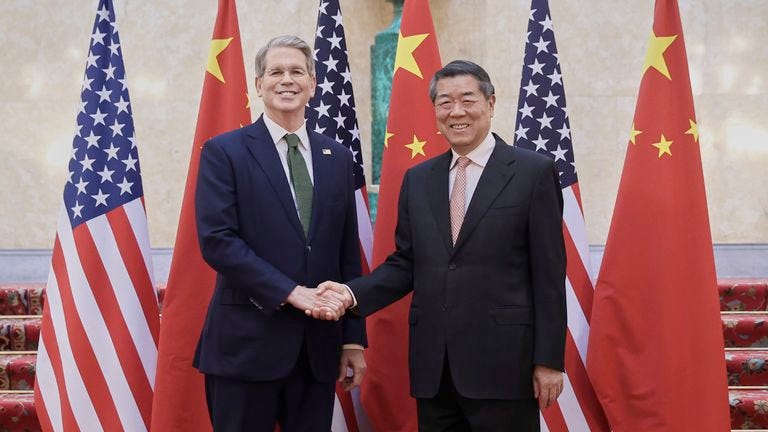
Donald Trump’s Secretary of Treasury, Mr. Scott Bessent, is lost in a delusion. Bessent’s recent public comments on tariffs and China illustrate his detachment from reality. He emphasizes that using high, targeted tariffs as leverage — framing them as necessary to counter what he describes as unfair Chinese trade practices — have not derailed a working trade “equilibrium” with Beijing. He has defended steep sector‑specific tariffs (steel, EVs, etc.) on China as a response to “dumping” and industrial overcapacity, pointing out that not only the US, but also Canada and the EU have at times adopted similar high tariffs on Chinese steel and related products.
Bessent has warned allies (especially Canada) that lowering their China‑focused tariffs or signing deals that let Chinese goods transit via third countries could trigger very high US retaliatory tariffs (he has explicitly mentioned the possibility of tariffs at or near 100% in that context). At the same time, he has said the US –China trade relationship has reached a “very good equilibrium” after the earlier tariff wars, stressing that tariffs pushed Beijing into a rules‑based framework where China is now, in his telling, honoring large purchase commitments (for example, soybean buying targets). He portrays the tariff pressure as having forced China to follow through on agreed purchases and commitments rather than as purely destructive, and says Washington will “hold their feet to the fire” to keep them compliant.
So let’s look at some actual facts… Since President Trump announced new tariffs on China in February 2025 (starting with a 10% tariff on all Chinese goods effective February 4, followed by escalations and retaliatory measures), China’s trade patterns have undergone significant shifts, with the overall impact igniting a shift in Beijing’s global export machine.
For starters, there has been a sharp decline in direct US trade. China’s exports to the United States fell by approximately 19-20% in dollar terms for the full year 2025 (some quarterly drops reached 23-40% in peak periods). US imports from China halved in certain months (e.g., January-May frontloading surge followed by contraction), with cumulative year-on-year declines turning negative by mid-2025. Bilateral trade volume contracted due to tariffs peaking at high levels (up to 145% on Chinese goods before partial rollbacks) and non-tariff measures (e.g., export controls on critical minerals).
China, unfazed by the US bullying, pivoted deftly to other markets. China posted a historic $1.189–$1.2 trillion trade surplus in 2025 (up ~20% from 2024), the largest ever recorded. Total exports grew robustly (e.g., +5-6% in late 2025 months), with overall growth around 5-6% for the year, outperforming global averages. And monthly surpluses exceeded $100 billion seven times (vs. once in 2024), supported by a weakened yuan and policy stimulus. What happened to Trump’s claim that “countries are lining up to kiss my ass” because of his tariff policy?
Instead of fretting about losing ground in the US market, China deftly pivoted to a policy of trade diversification. In Southeast Asia (ASEAN), exports surged +13-14%, driven by machinery, auto parts, electronics, and intermediate goods. This reflects rerouting (transshipment) through Vietnam, Malaysia, etc., for final assembly or labeling to bypass US tariffs. China’s exports to Africa jumped +25-26%, fueled by infrastructure-linked demand and Belt and Road ties. China also experienced gains in Latin America, growing around +7%, with increased shipments of manufactured goods and commodities. A similar result for Europe, where China’s exports rose +8-9%, helping offset US losses. These “Global South” and emerging markets absorbed redirected flows, with Chinese firms accelerating diversification strategies (e.g., special economic zones abroad, supply chain shifts).
On the import side of the ledger, imports from the US fell ~14-15%, reflecting retaliation and reduced demand for certain US goods (e.g., agricultural products, energy). Overall imports remained relatively flat or grew modestly (+5-6% in December), with China relying more on domestic stimulus and non-US suppliers. Putting it bluntly, China’s trade has become less US-centric and more globally diversified, with emerging markets and Asia filling the gap left by reduced US access.
Besides putting the US in a weaker position on the trade front — i.e., instead of expanding trade with China, the Chinese have decided to look for other partners — the commodity markets are broken. As of Saturday night east coast time, silver is trading in the US at a price of $85.15 per troy ounce. In Shanghai the Shanghai the silver benchmark (Ag(T+D) on the Shanghai Gold Exchange) at about ¥27,800 per kilogram, which is roughly $124–125 per troy ounce at current exchange rates. In a digital age that kind of gap cannot endure… In fact, it is irrational according to conventional economic theory. We are seeing a similar, albeit larger, gap in the gold market… Shanghai sits at $5,050 – $5,100 while the COMEX sits at $4,889.40. Investors who are flush with cash will not ignore this opportunity… They will buy in the US and sell in China until the arbitrage gap is closed (i.e., An arbitrage gap refers to the measurable price difference (or “spread”) between the same asset or equivalent assets trading in different markets, which creates a potential profit opportunity for arbitrageurs until it’s closed. That means more silver and gold will flow into China, not into the vaults at Fort Know.
Trump, in his desperation to preserve the economic hegemony of the US, has set in motion forces that are accelerating the erosion of US economic supremacy. Is Scott Bessent really this blind to the reality that is unfolding? Apparently so.
But this miscalculation by Trump extends beyond China. My dear friend, Alastair Crooke, has summarized the situation brilliantly in his latest SubStack:
The moment Trump embarked on his tariff war, the demand for dollars immediately dropped and the world started trading less with the US. In 2025, US exports — as a proportion of GDP — fell. Then came his supply chain and chip war with China, to decouple US dependency on Chinese inputs. Yet, to reshore US supply lines will cost a huge investment — requiring borrowing from the world. But why lend to the US? The ongoing debasement of the dollar is confirmed by the soaring price of gold and silver.
The Kiel Institute study also examined the unexpected tariff hikes imposed on Brazil and India in August 2025. The Report’s conclusion was the same as that for China. Again, the data show that foreign exporters did not lower their prices to offset the additional tariffs: “Both export value and volume to the US dropped sharply, by up to 24 percent. But unit prices—the prices Indian exporters charged—remained unchanged. They shipped less, not cheaper”.
What is happening is that Trump’s predicate that the ‘American market’ is so exceptional that no one can afford to ignore it, and exporters to its market must therefore ‘eat the costs’ of US tariffs — is in error. And this fact has been on display — with both Canada and Britain working to lessen their dependence on the US by turning East.
Pity poor Cuba, Venezuela, and now Mexico for being the low-hanging fruit that this administration will need to justify its kamikaze policies. The blowback that this will generate is no mitigation of the suffering of the ordinary people whose rulers had the temerity and impudence to serve by diverting the income flows destined for oligarchs and Wall Street to them. How dare they! And meanwhile the coke and fentanyl will just keep on coming. Great job, Donald!
😀 😃