
Why Does the West Hate Russia?

If you don’t do anything else this weekend while recovering from your Christmas hangover, please find the time to read, Jeffery Sachs: Two Centuries of Russophobia & Rejection of Peace, which is posted at Consortium News. Professor Sachs provides a compelling exegesis of the history of Russia vs. Europe that shows that the roots of Western hatred of Russia have little to do with Russian misdeeds or provocations.
Here is a snippet from a key section of the article explaining this idea:
That shift is captured with extraordinary clarity in a document highlighted by Orlando Figes in The Crimean War: A History (2010) as being written at the hinge point between diplomacy and war: Mikhail Pogodin’s memorandum to Tsar Nicholas I in 1853.
Pogodin lists episodes of Western coercion and imperial violence — far-flung conquests and wars of choice — and contrasts them with Europe’s outrage at Russian actions in adjacent regions:
“France takes Algeria from Turkey, and almost every year England annexes another Indian principality: none of this disturbs the balance of power; but when Russia occupies Moldavia and Wallachia, albeit only temporarily, that disturbs the balance of power.
France occupies Rome and stays there several years during peacetime: that is nothing; but Russia only thinks of occupying Constantinople, and the peace of Europe is threatened. The English declare war on the Chinese, who have, it seems, offended them: no one has the right to intervene; but Russia is obliged to ask Europe for permission if it quarrels with its neighbour.
England threatens Greece to support the false claims of a miserable Jew and burns its fleet: that is a lawful action; but Russia demands a treaty to protect millions of Christians, and that is deemed to strengthen its position in the East at the expense of the balance of power.”
Pogodin concludes: “We can expect nothing from the West but blind hatred and malice,” to which Nicholas famously wrote in the margin: “This is the whole point.”
Professor Sachs expands on Pogodin’s analysis with this penetrating summary:
Western Russophobia should not be understood primarily as emotional hostility toward Russians or Russian culture. Instead, it operates as a structural prejudice embedded in European security thinking: the assumption that Russia is the exception to normal diplomatic rules.
While other great powers are presumed to have legitimate security interests that must be balanced and accommodated, Russia’s interests are presumed illegitimate unless proven otherwise.
This assumption survives changes in regime, ideology, and leadership. It transforms policy disagreements into moral absolutes and renders compromise as suspect. As a result, Russophobia functions less as a sentiment than as a systemic distortion — one that repeatedly undermines Europe’s own security.
Now let me show you how that hostility is translated into policy by looking at the top eight largest US embassy compounds worldwide by land area (in acres), based on the most recent available data as of late 2025. Rankings prioritize facility size, with notes on personnel where reported. But I’m adding one more data point… The 2025 population estimates for each host country. First, peruse the list and then I’ll explain why I think the size of embassy compounds is something worth examining:
US Embassy in Baghdad, Iraq Facility size: 104 acres. Personnel: Downsized significantly; around 300–500 core staff (peak was 16,000+ in 2012). Host country population: ~47 million.
US Embassy in Beirut, Lebanon Facility size: 43 acres (new compound completed/expanded in recent years). Personnel: Not publicly detailed in recent figures. Host country population: ~5.8 million.
US Embassy in Islamabad, Pakistan Facility size: ~37 acres. Personnel: One of the largest staffs, historically ~2,500 (including security). Host country population: ~255 million.
US Embassy in Ottawa, Canada Facility size: ~30 acres. Personnel: Not specified in recent reports. Host country population: ~40 million.
US Embassy in New Delhi, India Facility size: ~28 acres. Personnel: Not specified in recent reports. Host country population: ~1.46 billion.
US Embassy in Riyadh, Saudi Arabia Facility size: ~26 acres. Personnel: Not specified in recent reports. Host country population: ~37 million.
US Embassy in Brasília, Brazil Facility size: ~23–25 acres (estimates vary slightly). Personnel: Not specified in recent reports. Host country population: ~217 million.
US Embassy in Yerevan, Armenia Facility size: ~22 acres. Personnel: ~400 (American and local staff combined). Host country population: ~3 million.
These sizes reflect the full diplomatic compounds (including grounds, housing, and support facilities), often built for security and self-sufficiency in challenging environments. Note that rankings can shift slightly with renovations or new constructions, and personnel numbers fluctuate based on mission needs. Smaller compounds (e.g., Beijing at ~10 acres) are excluded here as they fall outside the top eight. This is not just about acreage… It is also about the number of buildings on US-compound. Take a gander at the US Embassy compound in Yerevan. Notice anything unusual? How about the huge USAID building?
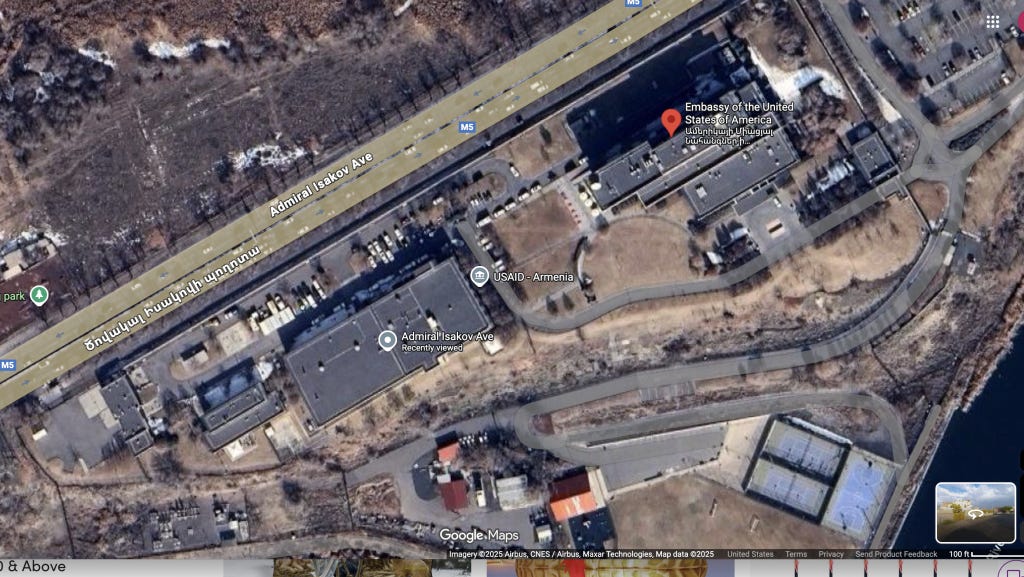
Why in the hell is the US Embassy Beirut and US Embassy Yerevan on this list? They are two of the smallest countries in the world in terms of population, but have larger embassy compounds than 160 other US embassies in the world. I think the old adage about real estate applies… Location, location, location. And by that I mean US national security priorities. Let me emphasize at the outset that I am not drawing on any previous information about military and intelligence personnel assigned to embassies in doing this analysis.
Obviously Beirut is in a strategic location because of its proximity to Syria and Israel, but what about Yerevan, Armenia? What catches my eye is that Armenia is strategically located between Georgia on the northern border of Armenia, Iran on its southern border and Turkey to the west.
Let’s look at USAID allocations to get some sense of whether or not Armenia is receiving a disproportionate share of USAID money. In terms of bulk numbers, Armenia’s rank is in the mid-tier range (around 55th–65th) among recipients, well below major recipients, but above smaller ones (e.g., those receiving under $20 million). However, when assessed on a per capita basis, the FY 2025 request of ~$52 million translates to approximately $17 per capita, which places Armenia in the top 20–30 among recipient countries globally—significantly higher than larger nations, but below small states or territories with intense strategic/humanitarian focus (e.g., Jordan, Lebanon, West Bank/Gaza, or Pacific islands). I don’t think this is a coincidence.
Let’s examine how western think tanks and the US government perceive Armenia. Think tanks like the RAND Corporation and US government sources (e.g., State Department reports) frequently highlight Armenia’s strategic location in the South Caucasus as a critical factor in regional geopolitics, emphasizing its role as a potential bridge or buffer between major powers like Russia, Iran, Turkey, and the West. Situated at the crossroads of Europe, Asia, and the Middle East—bordering Georgia to the north, Azerbaijan to the east, Iran to the south, and Turkey to the west—Armenia is seen as vulnerable yet pivotal for countering Russian influence, promoting energy diversification, ensuring border stability, and advancing Western integration amid ongoing conflicts like Nagorno-Karabakh.
RAND often frames Armenia’s location as precarious, wedged between authoritarian regional powers (Russia, Azerbaijan, Iran) and democratic aspirations, making it a focal point for US strategy in countering Russian dominance in the post-Soviet space. Key themes include:
Vulnerability and Russian Orbit: Armenia’s trajectory toward Western alignment is described as “extremely perilous,” with Yerevan remaining economically and militarily tied to Russia (e.g., through the Collective Security Treaty Organization and Eurasian Economic Union) despite deteriorating relations. RAND’s narrative emphasizes the belief that Armenia’s location exposes it to Russian coercion, especially post-2022 Ukraine invasion, where Moscow’s distractions have allowed Azerbaijani advances. RAND notes Armenia’s borders with Iran also heighten risks of illicit activities and hybrid threats.
Security Challenges with Azerbaijan: Faced with a hostile, militarily superior Azerbaijan (which seized Nagorno-Karabakh in 2020 and 2023), Armenia’s location amplifies threats of escalation and displacement. RAND argues the US cannot fully guarantee Armenia’s security due to escalation risks, but can support “porcupine” deterrence strategies (e.g., air defenses, counter-drone tech) to bolster resilience. This aligns with broader US interests in upholding border inviolability and preventing regional destabilization that could affect NATO allies’ energy flows.
Opportunities for Western Engagement: In rethinking the post-Soviet order, RAND sees Armenia (alongside Georgia) as a “democratic bright spot” for US influence, advocating multi-alignment (hedging between Russia, Iran, and the West) rather than full pivots. This includes exploiting Russia’s vulnerabilities to extend U.S. advantages, such as through economic reboots post-Iran sanctions relief. Analysts recommend careful U.S. strategy focusing on comparative strengths like institutional building and diplomacy to deepen ties without overcommitting.
Overall, both RAND and US government sources stress Armenia’s location as a double-edged sword: offering leverage for Western influence but requiring cautious support to avoid escalation. I am belaboring this point to illustrate that neither RAND nor the US government acknowledges the reality that such actions by the US are viewed in Moscow as a threat to Russia. If the tables were turned and Russia was engaged in similar programs in Central America or Mexico, the US government would view it as a direct threat to America. This confirm’s the prescience of Mikhail Pogodin’s analysis 173 years ago.
Danny at CapitalCosm interviewed Alex Krainer and me on Wednesday and I did my regular chat with Nima, only this time Nima is in Iran visiting family over the holidays:
I love Jeffrey Sachs! What an incredible person with such an incredible perspective and prescient ability. Would to God that DJT would listen to him instead of Susie Wiles or Steven Miller! I wish DJT would host Professor Sachs at Mar-a-Lago instead of SATANYAHU! Maybe then he’d have some kind of insight into the absolute destruction he’s doing to our country right now. Everything-& I do mean everything-goes back into the long history and
mis-characterization of intentions of others and purposes of those who created this “history” to fit their special narrative, so that they can nurse their special grudges against another’s country and people & foment their own agendas. When are we ever going to get over this?? Unfortunately I don’t think we will. As for the “regular people” who work for a living and are not the people with power, for our part we do not hate the Russian people or anyone else for that matter. People want to have food and clean water, have decent shelter, raise their families, worship as they please and be safe. That’s all it takes to be happy for most people. As we have so rudely be recently shown, we are actually ruled by Oligarchs-Adelson and Ackman and many others. THEY choose our President, we do not. And that’s how we were tricked into “voting” for the Trojan Horse, DJT. So don’t be too hard on yourself for not seeing this ahead of time. We were all fooled.
😀 😃