
Witkoff and Kushner Spend Almost Four Hours with Putin, but No Diplomatic Breakthrough

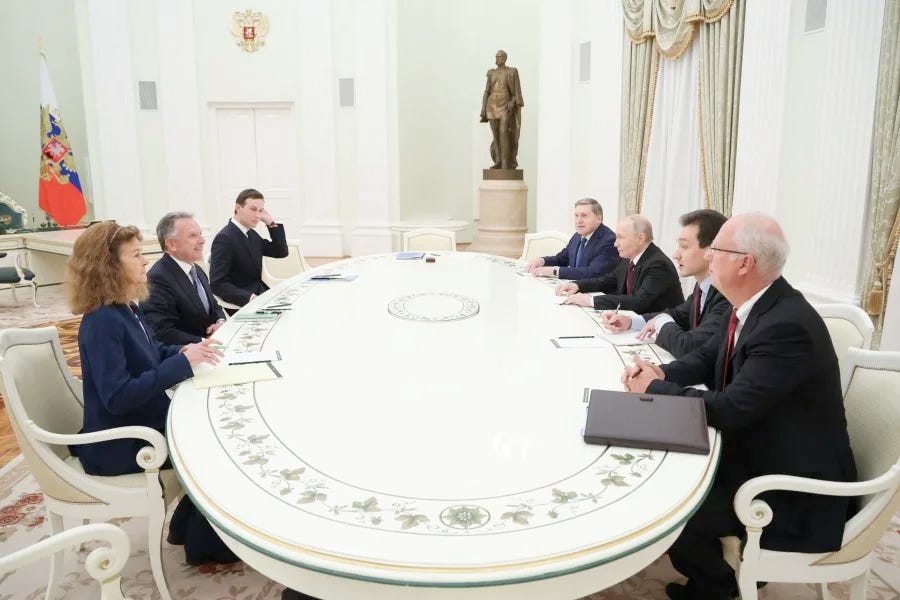
As I reflect on the just concluded meeting at the Kremlin with Vladimir Putin and his team on one side of the table and Steve Witkoff and Jared Kushner on the other side, the most significant result of the meeting is that Putin named the Chief of Russia’s military intelligence organization — i.e., the GRU — to head the Russian delegation that will meet on Friday, January 23, in Abu Dhabi with representatives of Ukraine and the United States. I will explain why that is remarkable and indicates where the negotiations currently stand.
First, let’s look at Sputnik’s summary of the meeting as told by Mr. Ushakov:
The negotiations between Putin, Witkoff, Kushner, and Grunbaum were constructive and extremely frank, Ushakov stated.
What else the presidential aide said following the meeting:
▪️ It was noted that without resolving the territorial issue, a long-term settlement cannot be expected.
▪️ It was agreed that the first meeting of the trilateral working group on security issues, involving representatives of Russia, the US, and Ukraine, will take place on Friday in Abu Dhabi.
▪️ They agreed that the first meeting of the Russia-US-Ukraine trilateral working group on security issues will be held in Abu Dhabi on January 23. GRU Chief Kostyukov will lead the Russian negotiating team.
▪️ The Russian delegation heading to Abu Dhabi has received specific instructions from Putin.
▪️ The heads of the bilateral economic working group, Dmitriev and Witkoff, will meet in Abu Dhabi.
▪️ The meeting focused on obtaining information about the outcomes of US contacts with Kyiv and Europe.
▪️ Witkoff and Kushner shared their impressions from the contacts that took place in Davos, including the meeting between Trump and Zelensky.
▪️ Russia will continue to consistently pursue the objectives of the special military operation as long as a settlement cannot be achieved through political and diplomatic means.
The key phrase is, constructive and extremely frank… That means there was a heated exchange of views and some very tough talk. Yet, at the end of almost four hours, there also was agreement to continue talking. Putin did not retreat an inch from the conditions for negotiations to end the war that he presented to senior Russian foreign ministry officials on 14 June 2024.
The meeting today (Friday) in Abu Dhabi of the Russia-US-Ukraine trilateral working group on security issues is not going to address conventional diplomatic issues that could lead to a peace agreement. This will be a meeting that focuses strictly on security and intelligence issues. Putin’s selection of GRU Chief Kostyukov is intended to send a clear message to both Ukraine and the United States.
Admiral Igor Olegovich Kostyukov (born February 21, 1961) is the current Director (Chief) of the Main Directorate of the General Staff of the Armed Forces of the Russian Federation (commonly known as the GRU or GU), Russia’s primary military intelligence agency. He has held this position since December 2018, making him the longest-serving GRU head in recent decades. He is the first naval officer (Vice Admiral/Admiral rank) to lead the traditionally army-dominated GRU.
As GRU Director, Kostyukov oversees foreign military intelligence collection, covert operations, signals intelligence, special forces (Spetsnaz GRU), and cyber activities. In early January 2026, Kostyukov appeared in Russian state media reports meeting with the US military attaché representative at the US Embassy in Moscow. He handed over materials (including a drone controller and decoded data) that Russia claims prove a Ukrainian UAV attack targeted President Putin’s residence in the Novgorod region on December 29, 2025. This was presented as evidence to “establish the truth” and resolve questions about the incident. The meeting was publicized by the Russian Defense Ministry, highlighting his role in diplomatic/intelligence exchanges amid ongoing tensions.
Normally a GRU Chief is not heading up a diplomatic initiative, but there have been instances in Russian (and Soviet) history where representatives of military intelligence—specifically the GRU (Main Directorate of the General Staff of the Armed Forces, formerly the Main Intelligence Directorate)—have headed up or played key roles in negotiations. These are relatively rare, as the GRU is primarily focused on military espionage, covert operations, and intelligence gathering rather than formal diplomacy (which is typically handled by the Foreign Ministry or civilian agencies like the SVR). However, the GRU has occasionally been involved in high-stakes, back channel talks, especially during the Cold War era when military tensions were acute.
The most prominent and well-documented example occurred during the Cuban Missile Crisis in October 1962, a 13-day standoff between the Soviet Union and the United States that brought the world to the brink of nuclear war. The GRU played a direct role in facilitating backchannel negotiations to de-escalate the crisis. Colonel Aleksandr Feklisov (operating under the alias “Aleksandr Fomin”), a senior GRU officer stationed in Washington, D.C., as the Soviet embassy’s intelligence rezident (chief). Feklisov was a seasoned operative with prior experience in espionage (e.g., handling the Rosenbergs in the US during the 1940s). On October 26, 1962, Feklisov initiated contact with John Scali, an ABC News correspondent with ties to US officials. Acting on instructions from Moscow (likely coordinated through GRU channels), Feklisov proposed a deal: The Soviet Union would remove its missiles from Cuba if the US pledged not to invade the island and removed its Jupiter missiles from Turkey. Scali relayed this to US Secretary of State Dean Rusk and President John F. Kennedy, serving as an informal conduit.
In selecting Admiral Kostyukov to lead the Russian delegation to the tripartite talks on security, Putin is strongly signalling that security issues for Russia are a top priority. Kostyukov knows how the CIA has propped up and enabled Ukrainian intelligence and terrorist operations against Russia. I believe that securing an agreement from the US and Ukraine to cease all attacks on Russian civilians will be a priority objective in the negotiations.
Here is the bottom line from Putin’s aide, Yuri Ushakov: Russia will continue to consistently pursue the objectives of the special military operation as long as a settlement cannot be achieved through political and diplomatic means. That is the critical message that Witkoff and Kushner will deliver to President Trump on Friday… Russia is not going to let up on its current military campaign and will continue to inflict massive damage to Ukraine’s infrastructure and military until Ukraine and NATO agree to end the war through negotiations.
The two key podcasts today were first with Danny Haiphong and Stas Krapivnik, followed by Garland Nixon:
😀 😃
Thanks Larry for fleshing out my initial thoughts on learning that the chief of the GRU is heading the Russian delegation to the tripartite talks. My other thought was that the meeting(s) between Whitkoff and Dmitriev is just a side-dish to keep Trump and his fellow billionaires interested in pursuing a rapprochement with Russia.